
How Should Monetary Policy be Made?
Is this a good example?

Bernanke,Is this a good example?
Americans often like to think they’re at the center of the universe or at least in the vanguard when it comes to the technical fields like science and economics. However, when it comes to monetary policy and actually doing it, US has really not been a top-tier program. The Federal Reserve may not see things that way but in the early 70s it was clearly the Bundesbank that was making rockstar monetary policy and evading the worst of the inflation consequences of high oil prices and navigating the new system of fluctuating exchange rates. It was New Zealand that led the way to inflation targeting. After Ben Bernanke put targeting in place in the US and took only two chairmen before the whole process fell completely apart. The US likes to think that it’s a model for the rest of the world and certainly the US fight for central bank independence put the Fed more in that light. But during COVID it was the Federal Reserve’s delay in raising interest rates that too much of the world emulated, spreading global inflation. The Fed looked into its rearview mirror and said, ‘oh, look the rest of the world did this…’ but the Fed was leading, and everyone else followed that pied piper. Be careful who you believe and follow and whose Kool Aide you choose to swallow. So, with that, let’s take a clear-headed look at the U.S. history of how monetary policy has been made. Welcome to the sausage factory.
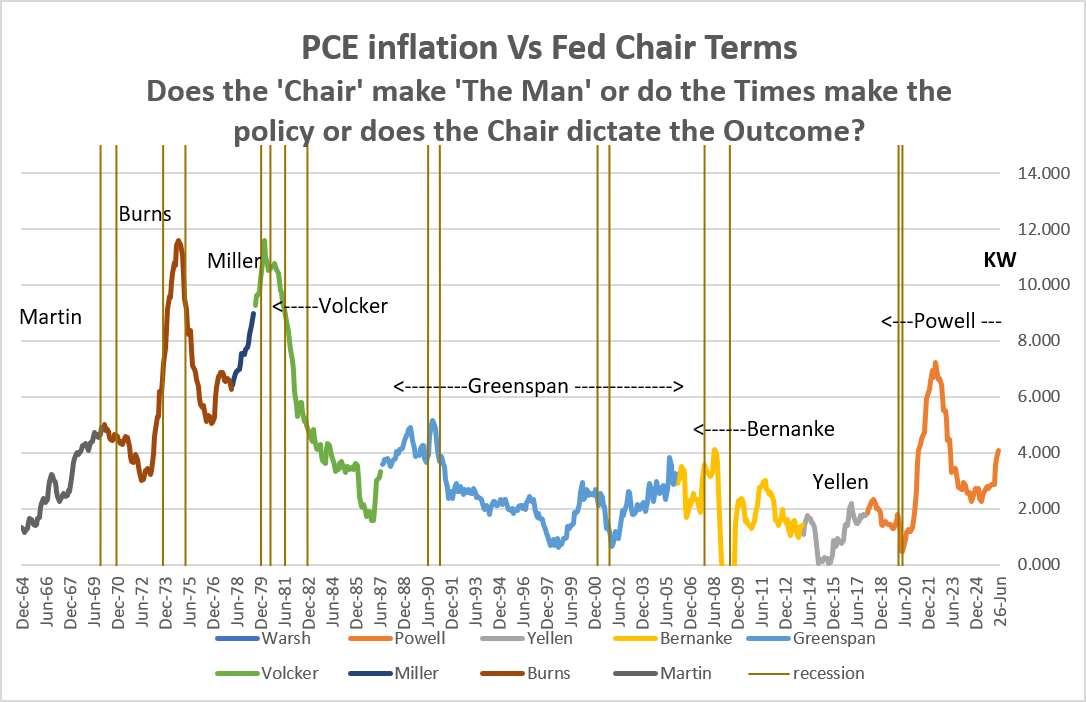
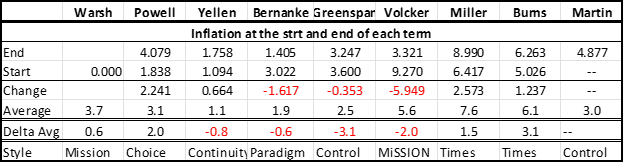
I start out by presenting the history of inflation across various Federal Reserve chairman’s terms of office. My data starts somewhere in the middle of William McChesney Martin’s term, and what we see here is the loss of control. High inflation in the 1970s. The loss of control begins under Martin; it gets well out of hand very quickly under Burns, G William Miller follows him, and has no clue what to do; he is unable to move fast enough to get ahead of inflation. Then Paul Volcker is brought in. That game-changer brings interest rates to draconian heights, crushes the economy with one short sharp recession and another much longer grinding recession, and eventually the inflation rate goes down. Volcker, for various reasons, leaves the scene Alan Greenspan steps in. Greenspan controls the inflation rate somewhere around the lows that Volcker achieved. He then eased inflation to a lower position, handing the ship off to Bernanke, who took charge during a difficult time as the Great Recession began. Post-recession and GFC (Great Financial Crisis) inflation for a while threatened the zero bound. Bernanke performed different kinds of central banking magic to try to preserve growth and avoid the perils of the zero bound. His term was followed by Yellen who kept inflation low and then Jerome Powell, who loses his mind to the notion of preserving low unemployment and threw the inflation mandate under the bus. The Fed continues to I think that inflation expectations remain grounded and anchored – but how is that possible after five years of failure? And now, of course, we have Kevin Warsh who looks back upon this varied slate of conditions, the particularly difficult situation that existed right before him and how we have five years of the inflation rate running over the top of its target and Warsh must decide what to do and how to do it. The ‘what; is obvious, the ‘how’ less so.
Warsh’s Challenge
Of course, his answer of what to do is to control inflation this is what has been missed terribly under the Powell administration unemployment is still low arguably still very much at full employment. But the inflation rate has gotten out of control and it’s being pressured again by largely geopolitical events but also to some extent by the presidents tariff policy. Warsh was appointed by this president and that is creating a problem for him since many view him as the president’s man at the Fed and the question is this: is he the Fed chairman, or is he the president’s man at the Fed?
Warsh’s history strongly suggests that he is the Fed chairman and if the president thinks that he’s going to get any special favors from him he is probably going to be disappointed - and this president does not like to be disappointed. However, because Jerome Powell fought back against the president’s attempt to remove him, the Fed is now more clearly protected under an umbrella created by a Supreme Court decision and so Warsh knows that while the president can make his life miserable, at least by the way he can speak in public, there isn’t much else that he can do. The president doesn’t really have any power over Kevin Warsh at this point.
Beyond inflation…
Beyond this chart which merely tracks the inflation rate and doesn’t track the level of interest rates it doesn’t track the growth rate in the economy and does not track the unemployment rate, and does not track many variables that we’re interested in, we know that making monetary policy is complicated. But history reveals that regardless of method it is the chairs who paid the most attention to keeping inflation low who did best. This observation isolates Burns. Miller and Powell. The economy has done some amazing things it’s been very resilient in the face of first of all the Great Recession a long slow recovery and then COVID and then the outbreak of war in the Ukraine and then a second outbreak against Iran and the current problems that exist in the oil markets and that center on the Strait of Hormuz.
Luck of the Draw
Monetary policy can be controlled an run any number of ways. But it is made in an environment that is little more than a straw in the wind and we never know what ill- wind will blow next. Some Fed chairs get tranquil times; some don’t. It’s partly the luck of the draw but it is also influenced by what past monetary policy did: the great endogenous/exogenous future. The Fed controls very little of that of that Despite eht the Fed itself will sometimes say. Martin and Burns did not control the formation of OPEC the breakdown of Bretton Woods or the decision to go to floating exchange rates, the Arab oil embargo and the many other things that monetary policy had to deal with at that time. G William Miller did not control the high inflation rate he inherited- but neither did he know how to deal with it.
Shocks =>, Hey Mon it’s not my job?
You’ve grown accustomed to referring to these unexpected things as shocks and the policymakers have developed a way of speaking about shocks that I find kind of, well, shocking It seems to be a way that apologizes for central bankers they have no tools to deal with supply shocks (sad) and seems to argue that since they can only affect demand monetary policy should ignore a lot of these shocks. However I think that this is a discussion that has gone too far afield. While I know that monetary policy cannot cause more oil to be pumped out of the ground and cannot restore broken supply lines- or heel the sick and raise the dead, for that matter- the key feature of these supply disruptions when they occur is that there is a reduction in supply relative to demand that causes prices to spike. The way to close that kind of supply-demand imbalance could also be to raise interest rates to reduce demand! You can’t increase supply with monetary policy but you can reduce demand and it seems that among central bankers there is no willingness to do that. But one of the important things that monetary policy can do when a shock occurs is to keep that impact on price from spreading and if there’s no reaction to the shock there’s a much better case to be made for the shock to spread. Ultimately, quite apart from the mechanical effect of monetary policy, what the Fed does sends a signal- it affects perceptions and expectations.
Making the sausage
During the monetary history that I have on the chart above with the multi colored Federal Reserve terms monetary policy making has evolved. There hasn’t been only one way of making it. Under William McChesney Martin, his view was that the Fed should as he said lean against the wind he also said it’s the Fed’s job was to take away the punch bowl when the party is getting into full swing. His reaction function was pretty clear even though that sort of terminology was not used in his day.
Arthur F burns was a bit more enigmatic and apparently placed a great deal of emphasis on business confidence and so became reluctant to raise interest rates and keep them up too long because he was afraid of ruining business confidence. He hadn’t really recognized that inflation could rise and be the danger that it turned out to be. Previously, in the post war period, inflation had been controlled in the US- exchange rates had been fixed, OPEC had not existed…and so on. It isn’t like we didn’t know about the dangers of inflation, the German hyperinflation was still something that was fresh in the minds of people who are aware of how monetary policy could work and go wrong. But the war was over, everyone was back home and working and no one was thinking about those sorts of things or disruptions. There was the Korean War and then eventually the Vietnam War but The World War took such a toll, these ‘minor skirmishes’ were not the focus of policy and the risk of oil prices tripling and more had not been considered. In the early days much of the talk about OPEC was about the stability of the Cartel- clearly just another way to think of its effect as potentially ‘temporary.’
Ignore inflation at your peril- the ratchet effect
Burns had to deal with the first OPEC price shock and the shift to fluctuating exchange rates in the early 70s the 1973-75 recession was a relatively severe one and under previous chair, Martin, the inflation rate had already moved up and there was a short recession early 1970 and after that recession the inflation rate did not go back to its pre-recession lows, but instead it moved up very sharply. The fluctuating exchange rate system ‘transmitted inflation’ (Price shocks) more freely and, as OPEC was formed, and as it raised prices, monetary policy in the US made its first mistake… That was actually a policy to try to soften the impact of rising oil prices by allowing inflation to creep in. that, it was argued would reduce the relative price shock of higher oil prices. There should be a lesson there about letting that camel get its nose out of the tent but even in the economy currently with oil prices having gone up, there is a reluctance to move monetary policy even today. Today we argue, ‘the bump up is temporary’…so is life.
Getting burned then salved
Eventually Burns did move interest rates up and got them up relatively high - even relative to inflation - but his big failure was not leaving rates high enough long enough so when the recession ended and the inflation rate went down, so did interest rate and too quickly. Once again, as the chart clearly shows, the inflation rate post-recession fell but was higher than the inflation rate had been pre-recession and this ratcheting effect of having inflation, recession, and then an elevated reflated inflation rate - and doing that again and again - created a very damaging environment. G William Miller followed Burns and the inflation was already accelerating further. Miller, a former corporate executive at Textron, was used to being in control but did not understand the Fed culture and may not have understood monetary policy well enough to understand what he really had to do. Either that or he found the likely consequences too repugnant, like Burns. Jimmy Carter who had appointed Miller lured him over to the treasury to become Treasury Secretary instead of Fed Chair opening the seat up for Paul Volcker who moved from the Federal Reserve Bank of New York to be Fed chair in Washington DC. Volcker who took office in August, by October 1979 had decided something really needed to change and he introduced shock treatment by moving the economy over to a monetarist operating framework, arguing that the Fed would place more emphasis on monetary aggregates growth and if money grew too fast interest rates would rise and if money fell out of its growth band interest rates would be cut. Burns had also used the money growth paradigm for policy and with five monetary aggregates as references he always found an aggregate that was performing in a way to justify what he wanted to do with policy. Volcker did not play the monetary aggregate Game of five card Monte Burns had played. Volcker simply used excess of money demand to generate rising and falling interest rates arguing that the Fed set monetary growth parameters and interest rates were then determined by the markets depending on economic growth and the evolution of money demand. Bingo, bango, bongo.
Volcker II
By the end of 1982 the high interest rate policy was grinding away at the economy and there were some technical factors in the mix the caused the Fed to decide that it would not be a strictly monetized as it had been up to that point The Fed had brought a fairly clean monetized operation since October of 1979 but late in 1982 the Fed basically stepped away from that and allowed interest rates to fall and as they did that the inflation rate also fell the Fed carefully measured program, as the Fed itself began to set rates on its own judgement. The decline in the federal funds rate that it then allowed relative to the developing inflation rates after this long period of high interest rates finally rates did fall sharply as you can see in the in the chart.
Fed chair maltreatment is not a one-off event
There’s a great focus these days on Donald Trump and the way that he publicly brutalized fed chair Powell at least verbally. This mistreatment of Federal Reserve officials is not a new phenomenon LBJ is reported to have even slightly physically accosted William McChesney Martin by physically pinning him to the wall while he demanded lower interest rates. Richard Nixon used other devious threats against Arthur F burns to try to motivate him to reduce interest rates. Jimmy Carter rose above the fray and replaced his unsuccessful appointee G William Miller with Paul Volcker by enticing Miller to quit. He did this even though his aides told him that appointing Volcker to that position would probably mean that he would not get reelected. Carter did it anyway. Ronald Reagan had had enough of these high interest rates and was able to appoint a controlling number of members to the Board of Governors who essentially created a palace coup on Volcker and undermined his control of monetary policy by approving a discount rate cut request from district banks undermining Volcker’s control of the FOMC and probably hastening his departure from the Fed.
The Greenspan years
Volcker was replaced by Alan Greenspan who was perhaps the most political of of Federal Reserve Chairman. He had been actively involved in Republican politics. But, Greenspan was also respected and had a long series of terms serving a supporting stewardship of the reduction in inflation that Paul Volcker had engineered. Greenspan offered no analytical model. One criticism of Greenspan is that this was all his judgment and looking back in retrospect it was pretty good judgment, but he did not create any framework to pass on. And in terms of wondering about what his reaction function might have been, Greenspan had said that it was the Fed’s job to control inflation and to make inflation so low that it was no longer an important factor in business decisions. So while he did not put a number on it he made it clear that controlling inflation was his objective. Despite having a dual mandate both Volcker and Greenspan had taken the position that the Fed didn’t control employment but did the most that it could for getting full employment by controlling inflation in this philosophy took the conflict out of the dual mandate. So next we have to wonder…Greenspan wanted inflation very low he even said close to zero, but he was followed by Bernanke who had the fear or of God installed by the proximity of inflation to zero as he worried about deflation. Imagine 15 years from Volcker addressing run-away inflation, about 20 years late Bernanke is worried about deflation. And unlike Greenspan and Volcker he stepped back from their approach that had taken the conflict out of the dual mandate, a move that put monetary policy back on a bad path
Bernanke: The GFC and inflation targeting and ample reserves
Greenspan turned the Fed’s helm over to Bernanke with inflation in pretty good shape. However, Greenspan had been a deregulationist and had always believed in the probity of the private sector because no firm would act in a way to undermine its own integrity and reputation; that belief became his undoing as the mortgage crisis unfolded and all sorts of corner-cutting, bad practices, and overall financial sloppiness emerged. They came together in a perfect storm that became the great financial crisis (GFC). Greenspan was shocked by it and there were traces of it having started at the end of his term, which he chose to ignore, telling his mortgage specialist on the Board of Governors Ned Gramlich not to worry about it and to let the markets sort it out. That may have been Greenspan’s biggest mistake. Greenspan passed the torch to Ben Bernanke who then was Fed chairman when this crisis struck. Bernanke spang into action establishing all kinds of special facilities in order to stabilize financial markets. When it was done the financial sector looked very different and in the wake of it the economy was weaker. This has since come to be called the Great Recession, the economy had limped into recovery with a high unemployment rate that came down very slowly The inflation rate that Volcker and Greenspan has wrestled with suddenly was low, stayed low, inflation became so controlled Bernanke eventually was able to switch the Fed in January of 2012 over to inflation targeting (a 2% target) but to do that he had to backtrack on some of the most significant and effective decisions made by Paul Volcker and Alan Greenspan and reintroduce the short term Phillips curve so that Congress would approve his interest rate targeting with a still significant weight on employment.
In hindsight I think that this eagerness by Bernanke to implement inflation targeting was his undoing because although he promised us all kinds of great results by engaging in inflation targeting since it was a dual mandate the Fed was never going to be able to commit itself relentlessly to a 2% inflation target. There would come times when the Fed would have to divert its attention under its responsibility of the dual mandate. However, that never happened during Bernanke’s term he never had to face the internal inconsistency that he had created having inflation targeting in the presence of a dual mandate.
Yellen tries to get the Fed funds rate up to neutral
Janet Yellen followed Ben Bernanke and she dealt with the inflation rate quite well keeping it extremely low during her term. Yellen had the lowest inflation rate of any Fed chair on average during her term, however, she was more concerned with the low level of the federal funds rate and took steps repeatedly and tried to raise fed funds even though inflation was controlled and was well under the Fed’s target. She raised rates on a very consistent basis and laid the groundwork for great criticism against the Fed because she was acting in this preemptive way of raising interest rates while the Fed was missing its inflation target on the low side. Hiking rates did not seem like the requisite policy. The Fed got the reputation for being too preemptive and eventually Elizabeth Warren warned the Fed at one point later on…She threatened Jerome Powell about being too preemptive with monetary policy. Yellen was not reappointed to a second term.
The Powell regime
Yellen was followed by Jerome Powell Who took over in early 2018 and kept to the schedule of unrelenting rate hikes even late in December of 2018 when it was clear that a rate hike wasn’t needed but when Powell wanted to make sure that he did not disappoint markets that had been led to believe there would be a hike. The Fed had wanted for some to get interest rates with some space between the zero boundary and the low level of the Fed funds rate near zero, where rates had been for so long. But, it turns out that the Fed in its ambition to get rates off the zero bound, had raised rates too much, and after mid-2019 the Fed was cutting rates and then in 2020 COVID struck.
The Covid caper
COVID was largely misunderstood. At the time the reaction of the government and the press was such that the public became very frightened of the disease and its potential to kill although information existed even in mid 2020 that strongly suggested that the virus was not as lethal as people had feared or as it had been portrayed. The ongoing evolution of the virus further, progressively, weakened its impact. And despite shutting the economy down, shutting schools, and everything the government did, the COVID virus was never the leading cause of death in America. Heart disease and cancer continued to kill more people than did the virus that we were all made to fear. That virus and how it was treated by the authorities, was much more public health care catastrophe than it was a pandemic that threatened the health of Americans. COVID largely killed people with ‘the wrong’ pre-existing medical conditions; people who got COVID and didn’t have pre-existing conditions were very unlikely to die. Health statistics from New York City made it clear that in that city fewer than 2% of the people who died we’re healthy people. Over 98% of the people who died had some medical pre-existing condition. Yet Covid stopped the economy in its tracks and was responsible for severe interruption in the education of many students with lingering effects even today.
A shut down economy and a new framework agreement for targeting
Nonetheless the economy was shut down fiscal and monetary policy went to great lengths to try to bring the economy back to life, the efforts were more than what was needed and the economy came back to life and generated a great deal of inflation at the end of 2021 the Federal Reserve formally looked back at the Bernanke inflation targeting arrangement and then refreshed the framework in a way that was quite mistaken at the same time. The Fed decided inflation was well behaved and in 2000 adopted a new framework that committed the Fed to be not preemptive and in fact to wait until inflation had been in excess for a while before raising rates and to not hike rates until the economy was at full employment. This was a terrible recalibrated framework for a central bank as it directed the Fed to ignore its main responsibilities. Chair Powell’s term of office was expiring and he was careful not to be too preemptive by raising interest rates, in fact, he waited over a year to raise interest rates after inflation moved up over the fed’s 2% target. Historically, I think the slowest in the worst response of any Federal Reserve to an increase in inflation. The Fed used a number of novel excuses as to why they could not raise rates arguing that inflation was temporary and that it was a supply shock and there was going to be over soon and then at another point that it had a taper in place and it couldn’t run policy at cross-purpose to its own policies by adding reserves and raising rates at the same time. < However, about two years later the Fed opted to do exactly that> Then Powell waited until after he was renominated and reappointed when the Fed did begin raising interest rates.
The Fed finally hikes rates
By that time inflation had gotten terribly out of hand and the Fed had a huge job ahead of it. With Powell in his second terms the Fed engineered an unprecedented 4 consecutive rate hikes of 75 basis points. But then it stopped after it got the level of the Fed funds rate up close to the inflation rate. The Fed, under Powell, like the Fed under Arthur F Burns, in the 1973-75 recession got approximately the right interest rate in play but became unwilling to raise it further to knock the inflation rate down; instead the Fed kept interest rates at the same level and eventually inflation began to fall. When that happened the Fed came in and began cutting interest rates in a very persistent fashion. Under Burns rates were dropped far too fast. Under Powell the careful rate reductions did not track inflation or demand that inflation continued to fall. The Powell Fed asserted that policy was restrictive and cut rates even when inflation was no longer falling and even in the face of new potential inflation threats like tariffs and a war – and did so with inflation already running at a pace above target. Rodney Dangerfield got more respect than the 2% inflation target under Powell.
The process of rate cutting after Covid
The Fed began to cut interest rates in September of 2024 and in August the PCE headline rate had fallen to 2.4% after having been much higher so the Fed gave us a 50 basis point rate reduction and two other rate reductions and in response to that inflation rates stopped falling. The Fed later introduced 3 more rate cuts of 25 basis points each and in the wake of the second bath of cuts, the inflation rate actually started to rise. During this period the inflation rate was higher than the Fed’s target but chair Powell was committed to cutting rates to achieve what he called a ‘soft landing’ which was going to be his legacy as Fed chairman. He was going to pull a rabbit out of his hat and he was going to be remembered for having done something that no one had done before him - except that it didn’t work. Powell continued on this path and as he presided over these various rate reductions the inflation rate stopped falling and then started rising and Powell was oblivious to it. He kept this committee in line and for the most part there were very few dissents. Late in his term Stephen Miren was put on the board as a member for a few months and he began to dissent wanting the Fed to cut interest rates more even though inflation is still running over the top of the target but Steve Miren was a Trump appointee and while he was on the Fed he did not resign his position as head of the President’s council of economic advisers, he just took a leave of absence. Setting Miren’s dissents aside, there were very few descents until the last meeting that Powell presided over when there were four policy descends, Miren, again wanting interest rates lower, and three others wanting interest rates higher. The committee had finally come to its senses, looked at five years of overshooting inflation, and decided that continuing to do that was crazy. Next Kevin Warsh took over and this is now the committee and the circumstances he inherited.
Inflation policy in retrospect
Loking up the chart of inflation performance it’s clear that this has been the worst inflation performance since Volcker broke the back of inflation the clearly the worst performance since Arthur F Burns. Powell has remained on the committee as the governor no longer as chairman his policies are being more thoroughly repudiated as various FOMC members are looking to reverse the rate cuts they engineered and the more economists who had been in opposition to those policies all along are having more attention paid to their views. I will not say that more economists are becoming critical, although that may be true, too. But it’s clear that there were a number of economists who were critical of these policies all along the way and that they were simply ignored.
...and where were the markets? Did the vigilantes die or retire?
One strange artifact of this. Is that the Fed has missed its targets for five years running missed him fairly badly and that inflation clearly got stuck at about 3% with a target of 2% and now with more adverse global circumstances the inflation rate is rising and also at a time where the president has introduced tariffs and yet there’s precious little evidence that inflation expectations are not anchored by the Fed would like them. Then this raises some real questions to me although it hasn’t seemed to raise questions among the rest of the profession. I don’t really understand how The Fed can miss its targets for five years running and still not have a clear fire in its belly to get control of inflation or why the markets would continue to expect future inflation to get back down to its target. This makes me very distrustful of the measures that are being used to confirm that inflation expectations are actually controlled because it doesn’t make any sense to me that they would or should be controlled under these circumstances. The survey of inflation expectations across a broad audience of the ‘man in the street’ (if you will) from the University of Michigan shows relatively high inflation expectations according to the median and the mean of its surveys. The Fed for the most part has tried to reject and ignore the Michigan survey and I’ve argued that that’s not a good idea. If the Fed sees a group of people whose inflation expectations are agitated the Fed should be concerned about that it should not be dismissive. It that the Fed looks at the various market measures that remain quite subdued that reassures it. Why are they subdued? Where are the realists and the skeptics- after five years of missing? What are the markets doing?
Warsh breaks away
So Kevin Warsh inheriting this committee from chair Powell not knowing if he is going to have a dovish committee or not and having seen a relatively dovish Fed through the terms of Bernanke, Yellen, and Powell, he decided that he would form task forces to try to get advice how policy should be calibrated and conducted.
Warsh in Context
Warsh is an interesting fellow because he comes to the Fed as a former governor who has experience who has a voting record and with this track record we know that he has been basically more to the hawkish side and has when somebody who has voted consistently to control inflation. However, he was appointed by Donald Trump and Trump has made it very clear that he wants interest rates lower and this has undermined worse significantly and so it’s hard to say how markets really look at him. Some clearly see him as a change of pace who they expect to control inflation while others see him as an instrument of the present president who’s looking for an excuse to cut interest rates. Warsh has been talking about all the investment in AI and how it could stimulate productivity. A lot of analysis has been diverted to look at that and it’s clear that if productivity is kicked off that may not necessarily be a reason for the Fed to cut interest rates. While higher productivity will be good for growth in may also help to keep some inflation forces at bay it will stimulate the economy and economic activity and in all likelihood the equilibrium interest rate will be higher in a condition with more rapid productivity growth. The complications to monetary policy just keep on rolling in.
Summing up
I hope this recitation - this casual recitation - of past monetary policy and Fed chairs and how they operated and a little bit about the political legacies that existed—is useful to you. It’s good to look back and to remember the things that we did and how monetary policy was conducted. Even Fed chairmen who were quite successful like Alan Greenspan did not leave us much of a legacy that we could build on with the exception that Greenspan believed that inflation had to be kept low. Ben Bernanke who didn’t really give us much structure for monetary policy either, but who endorsed the system of inflation targeting that we still have, did not leave many mechanics that he endorsed to help us understand how we expected to get the result that he wanted. And with the dual mandate lurking in the background as the torch was passed from Bernanke to Yellen and Powell something strange happened as Powell flipped the dual mandate and threw the inflation goal under the bus.
I’m sure Warsh and his committee members—certainly the task force recommendations- are going to try to construct something that will try to prevent that from happening again. But the lesson of history is that regardless of what we know we seem to be making the same mistakes over and over again.
Form Volcker to Bernanke we went from fear of hyperinflation to fear of deflation in less than twenty years. Prices were stable in the post war period and then under Martin and Burns inflation got loose and the central bank lost its focus on keeping inflation down. We had a very painful decade a very high inflation and now we have a somewhat uncomfortable half-decade period of not quite that high inflation but inflation high enough that it makes a difference, and it’s uncomfortable. Will Warsh be successful? Will he get control? Well it’s hard to know. I think he will. But it’s hard to know
i
.
END